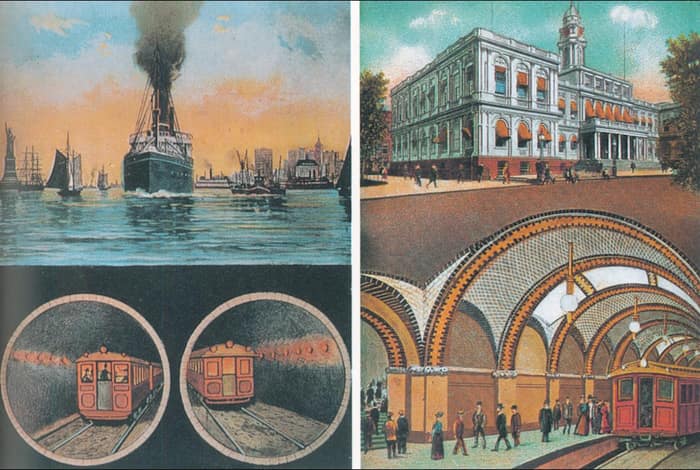
Joralemon Street Tunnel, the First Subway Under the East River
The Joralemon Street Tunnel is a pair of subway tubes that carry the 4 and 5 trains under the East River between Bowling Green in Manhattan and Brooklyn Heights. It opened in 1908 as the first underwater subway tunnel between the two boroughs. You cannot walk it, but you can ride through it, and a disguised house at 58 Joralemon Street hides its emergency exit.
A cast-iron tube 95 feet under the East River, a rebuilt ceiling and a Brooklyn row house that is only a front: the first subway link between Manhattan and Brooklyn hides more than it shows.
The history of the Joralemon Street Tunnel
The tunnel grew out of the plan for the city’s first subway. The Rapid Transit Act of 1894 set it in motion, and a team led by the engineer William Barclay Parsons drew up the route. The first contract did not include the section under the southern end of Broadway, so the Board of Rapid Transit Railroad Commissioners asked Parsons to study an extension south to South Ferry and on to Brooklyn. In 1901 it chose a route under the East River and Joralemon Street. The contract for that extension was signed on September 11, 1902.
Construction began in Manhattan on March 4, 1903, and in Brooklyn on July 10 of the same year. Six tunneling shields were driven, two from Manhattan and two each in both directions from Brooklyn, all of them inside a pressurized environment, with workers entering through air locks. The finished tubes are about 6,550 feet long and 15.5 feet wide, lined with cast-iron rings covered with concrete. At their lowest, they lie 91 to 95 feet below the mean high water level of the river. The Manhattan end goes through solid rock, while the Brooklyn end goes through sandy ground.
The sand was a problem. Shifting soil damaged buildings along the route in Brooklyn, among them the house of the Brooklyn borough president, and the city began paying compensation in 1906. There were blowouts and cave-ins, including a blast that killed one worker in October 1906. In March 1905 crews found the remains of a ship under Joralemon Street. Parsons and his successor George S. Rice then discovered that the ceilings of the tubes had sagged, so that trains could scrape the roof at speed.
The contractor chose to keep digging and to rebuild the faulty sections later. The north tube was holed through on December 15, 1906, followed by the south tube on March 1, 1907. Beginning in mid-1907, some 1,957 feet of the north tube and 962 feet of the south tube were reconstructed, with the lower half of each ring replaced by an elliptical section. The contractor went insolvent in May 1907 and a receiver finished the job. The first test train ran on November 27, 1907.
The tunnel and Borough Hall station opened to the public on January 9, 1908, with firecrackers and music on the steps of Brooklyn Borough Hall. It took pressure off the Brooklyn Bridge and the East River ferries, which had been the only passenger links. Later it became part of the IRT’s Lexington Avenue Line, was added to the National Register of Historic Places in 2006, and was flooded by Hurricane Sandy in October 2012 before reopening within the week. More extensive repairs followed in 2016 and 2017.
Little-known facts about the Joralemon Street Tunnel
- When it opened, it was called the Brooklyn–Battery Tunnel, a name later used for a road tunnel slightly to the south.
- 58 Joralemon Street is a real row house, built in 1847, that the subway company bought in 1907 and gutted to use as a ventilation and emergency exit building.
- When the tubes opened, 18 signals divided them into fixed blocks, and trains could run at up to 60 miles per hour.
- Construction crews discovered the remains of a ship under Joralemon Street in March 1905.
- Two construction shafts were dug: the one at South Ferry became a ventilation shaft in the Battery, while the one at Henry and Joralemon Streets was later filled in.
- It is one of seven East River subway tunnels that Hurricane Sandy flooded in 2012.
Tours near Joralemon Street Tunnel
Experiences in the area that you can book online with Viator:


Riding and seeing the Joralemon Street Tunnel
- The tunnel is part of the working subway and cannot be visited on foot. The way to experience it is to ride the 4 or 5 train between Bowling Green in Manhattan and Borough Hall in Brooklyn.
- At the Manhattan end, Bowling Green station sits beside Bowling Green Park, close to the Battery. The Brooklyn end is at Joralemon and Clinton Streets, where a cut-and-cover section links to Borough Hall station.
- In Brooklyn Heights you can see the front of 58 Joralemon Street from the sidewalk. It looks like an ordinary row house but contains tunnel ventilation equipment. Please respect it as a working facility and stay on the public sidewalk.
- Brooklyn Heights has quiet streets of historic row houses and a waterfront promenade, so the stop combines well with a walk. Check the current service patterns before you go, since subway service changes.
Opening hours, access and conditions can change. Check before you go.
Map: where Joralemon Street Tunnel is
Photos of Joralemon Street Tunnel


Where to stay near Joralemon Street Tunnel
Hotels close by, with ratings and current availability.

1 Hotel Brooklyn Bridge
Check availability ›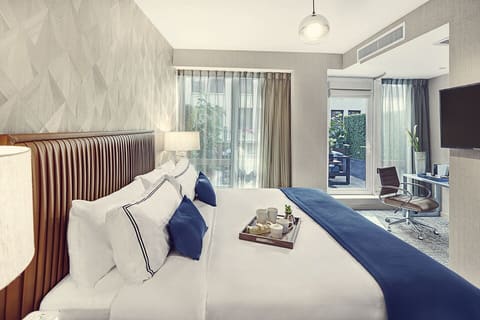
Artezen Hotel
Check availability ›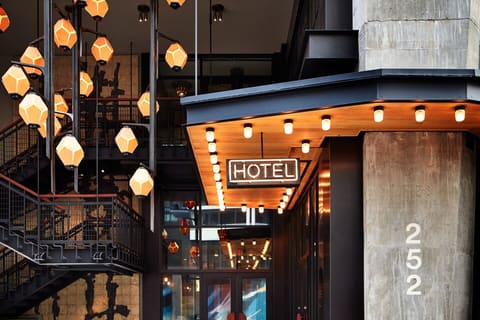
Ace Hotel Brooklyn
Check availability ›Hotel photos: Expedia Group. Ratings are shown as published there. Availability and conditions change; check the booking page. Affiliate links: we may earn a commission at no extra cost to you. All hotels by borough
Questions
What is the Joralemon Street Tunnel?
It is a pair of subway tubes that carry the 4 and 5 trains under the East River between Bowling Green in Manhattan and Brooklyn Heights. It was the first underwater subway tunnel between Manhattan and Brooklyn.
When did the Joralemon Street Tunnel open?
It opened to passengers on January 9, 1908. The first test train had run through it on November 27, 1907.
Can you walk through the Joralemon Street Tunnel?
No. It is an active subway tunnel and is closed to pedestrians. You can ride through it on the 4 or 5 train.
How deep is the Joralemon Street Tunnel?
At their lowest, the tubes lie about 91 to 95 feet below the mean high water level of the East River.
What is the fake house at 58 Joralemon Street?
It is a real row house from 1847 that the subway company bought in 1907 and emptied to use as a ventilation building and emergency exit for the tunnel.
Why was the tunnel partly rebuilt?
Engineers found that the ceilings of the tubes had flattened downward in soft ground, so part of each tube was reconstructed in 1907 before the tunnel opened.
Also nearby

James Watson House
James Watson House · a 1793 mansion facing Battery Park
800 m away
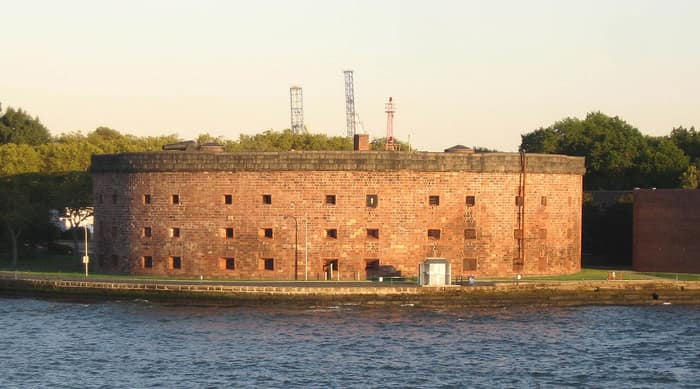
Castle Williams
Castle Williams · round 1811 fort and former military prison
1 km away
Cobble Hill Tunnel
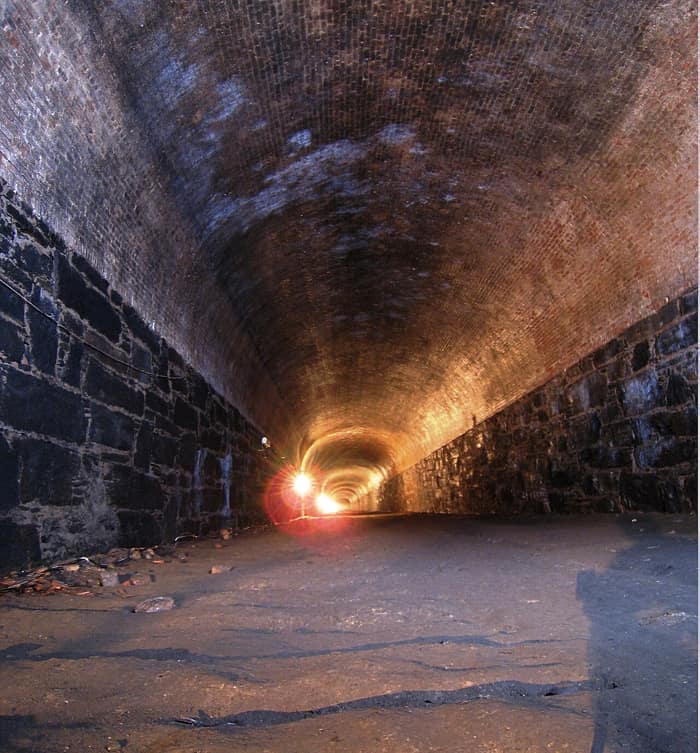
Cobble Hill Tunnel · Brooklyn’s sealed 1844 railway tunnel
1 km away
Trinity Church Cemetery
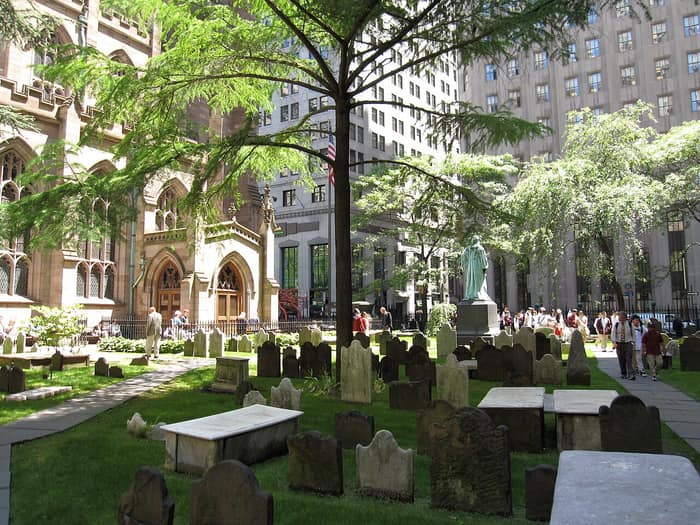
Trinity Church Cemetery · Hamilton’s grave beside Wall Street
1.5 km away