
Fort Lafayette, the Vanished Island Fort Under the Verrazzano Bridge
Fort Lafayette was a small island fortress built on a natural shoal called Hendrick’s Reef, just offshore from Fort Hamilton at the southern tip of Bay Ridge in Brooklyn. It guarded the Narrows, held Civil War prisoners and was one of the few historic American coastal forts to be demolished. Nothing of it can be visited today, but its story is part of what lies beneath the bridge.
A Civil War prison nicknamed the “American Bastille” once stood on a reef in the Narrows. It was torn down around 1960, and a tower of the Verrazzano-Narrows Bridge now stands on its foundations.
The history of Fort Lafayette, from Fort Diamond to bridge tower
Fort Lafayette stood on Hendrick’s Reef, a natural shoal in the Narrows, the strait that leads into New York Harbor. Work began around the time of the War of 1812 and was completed in 1822, as part of the continuing build-up of American seacoast defenses. The fort was a square set on its corner, a shape that gave it its first name, Fort Diamond. It was later renamed in honor of the Marquis de Lafayette, the French hero of the American Revolution, who made a famous tour of the United States in 1824 and 1825.
The fort was built of sandstone, brick and mortar, and held roughly 72 cannon, according to sources that vary, in three tiers: two in casemates and one on the roof. Its guns on the southwest front could fire on ships entering the Narrows from the Atlantic. It was, however, vulnerable to attack from the land side, which is why nearby Fort Hamilton was built about a decade later to protect it. In the 1840s Robert E. Lee, then a captain in the Army Corps of Engineers, worked on repairs and improvements to the fort, along with several others on the coast.
During the Civil War the fort became a prison, mostly for civilians seen as disloyal to the Union and for Confederate prisoners, including political opponents held under Abraham Lincoln’s suspension of habeas corpus. Some called it the “American Bastille”. Francis Key Howard, the editor of a Baltimore newspaper and grandson of Francis Scott Key, was held here in 1861 after criticizing the policy, before being moved to Boston. Robert Cobb Kennedy, a Confederate officer who took part in the 1864 plot to burn New York, was the only conspirator caught. He was hanged at the fort on March 25, 1865.
After a catastrophic fire in 1868 the fort was rebuilt. In 1883 Edmund Zalinski used it for experiments with his dynamite gun, which the Army and Navy briefly adopted. From 1898 to 1946 the Navy used it for ammunition storage and transfer. Then came the Verrazzano-Narrows Bridge. The fort was demolished around 1960 so the Brooklyn tower could be built on its foundations, one of the few American historic coastal forts to disappear in this way.
Little-known facts about Fort Lafayette
- Its first name was Fort Diamond, because the fort was laid out as a square set on its corner.
- The fort was renamed for the Marquis de Lafayette, the French hero of the American Revolution who toured the United States in 1824 and 1825.
- During the Civil War it was nicknamed the “American Bastille”, a comparison with the notorious Paris prison, because many of its prisoners were held without trial.
- A Confederate officer, Robert Cobb Kennedy, was hanged at the fort on March 25, 1865. He was the only person caught in the plot to burn New York in November 1864.
- In 1883 an inventor, Edmund Zalinski, tested a dynamite gun here that the Army and Navy briefly adopted.
- The Brooklyn-side tower of the Verrazzano-Narrows Bridge now occupies the fort’s former foundation site.
Seeing Fort Lafayette’s site today
- Nothing of the fort can be visited: it was demolished around 1960 and its place was taken by the Brooklyn tower of the Verrazzano-Narrows Bridge.
- The best way to feel the setting is from the Bay Ridge shoreline, where you can see the Narrows and the bridge tower. Check what public viewpoints are open before you go.
- Fort Hamilton, built on the shore to defend Fort Lafayette, is an active Army post with restricted access, and its Harbor Defense Museum presents the military history of the Narrows. Check the current access rules.
- Fort Wadsworth, across the Narrows on Staten Island, is a sister fort and the closest other historic harbor defense in the area.
- Photos and prints of the fort, such as those by Deloss Barnum, are the best way to picture it.
Opening hours, access and conditions can change. Check before you go.
Map: where Fort Lafayette is
Photos of Fort Lafayette


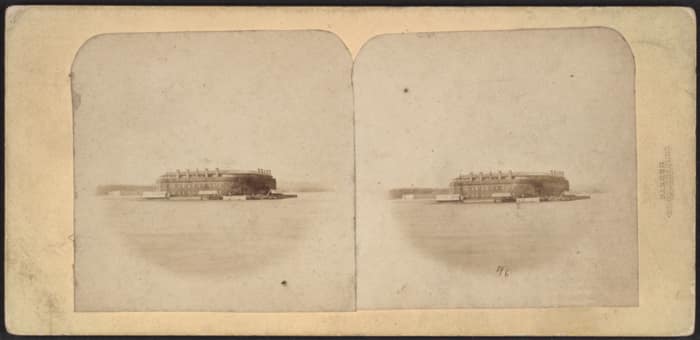
Where to stay near Fort Lafayette
Hotels close by, with ratings and current availability.

Hotel Le Bleu
Check availability ›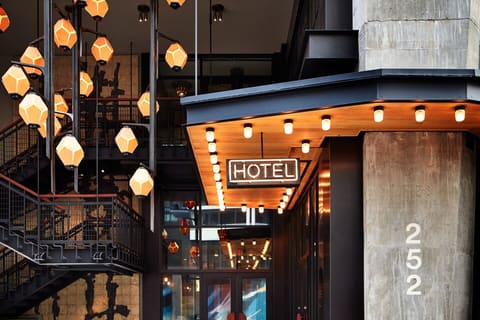
Ace Hotel Brooklyn
Check availability ›
EVEN Hotel Brooklyn by IHG
Check availability ›Hotel photos: Expedia Group. Ratings are shown as published there. Availability and conditions change; check the booking page. Affiliate links: we may earn a commission at no extra cost to you. All hotels by borough
Questions
What was Fort Lafayette?
It was an island coastal fort built on Hendrick’s Reef in the Narrows, completed in 1822. It later became a Civil War prison and was demolished around 1960.
Where was Fort Lafayette?
Offshore from Fort Hamilton, at the southern tip of Bay Ridge in Brooklyn. The Brooklyn tower of the Verrazzano-Narrows Bridge now stands on its former site.
Can you visit Fort Lafayette?
No, it no longer exists. You can see the Narrows and the bridge tower from the Brooklyn shoreline, and nearby Fort Hamilton has restricted access as an active Army post.
Why was it called the “American Bastille”?
During the Civil War it held many civilians and political opponents detained when habeas corpus was suspended, and critics compared it to the Bastille prison in Paris.
Why was Fort Lafayette first called Fort Diamond?
Because the fort was a square set on its corner, giving it the shape of a diamond. It was later renamed for the Marquis de Lafayette.
Who was held at Fort Lafayette?
Confederate prisoners and civilians seen as disloyal, including the Baltimore editor Francis Key Howard and Robert Cobb Kennedy, who was hanged here in 1865.
Also nearby

Fort Hamilton
Fort Hamilton · Brooklyn’s harbor fort and Army post
700 m away

Fort Wadsworth
Fort Wadsworth · Staten Island’s harbor fortress on The Narrows
1.5 km away

Battery Weed
Battery Weed · a four-tier stone fort at the Narrows on Staten Island
1.5 km away

Alice Austen House
Alice Austen House · Dutch colonial home and photography museum
2 km away